

Last updated: January 14, 2026
Short answer: Yes, for most Texas homeowners.
If you’ve ever opened your electricity bill in July and immediately regretted buying that house with the west-facing windows, you already know why solar panels make sense in Texas. We use more electricity than almost anywhere in the country, thanks to running air conditioning from May through October, and that gives solar a lot of cost to offset.
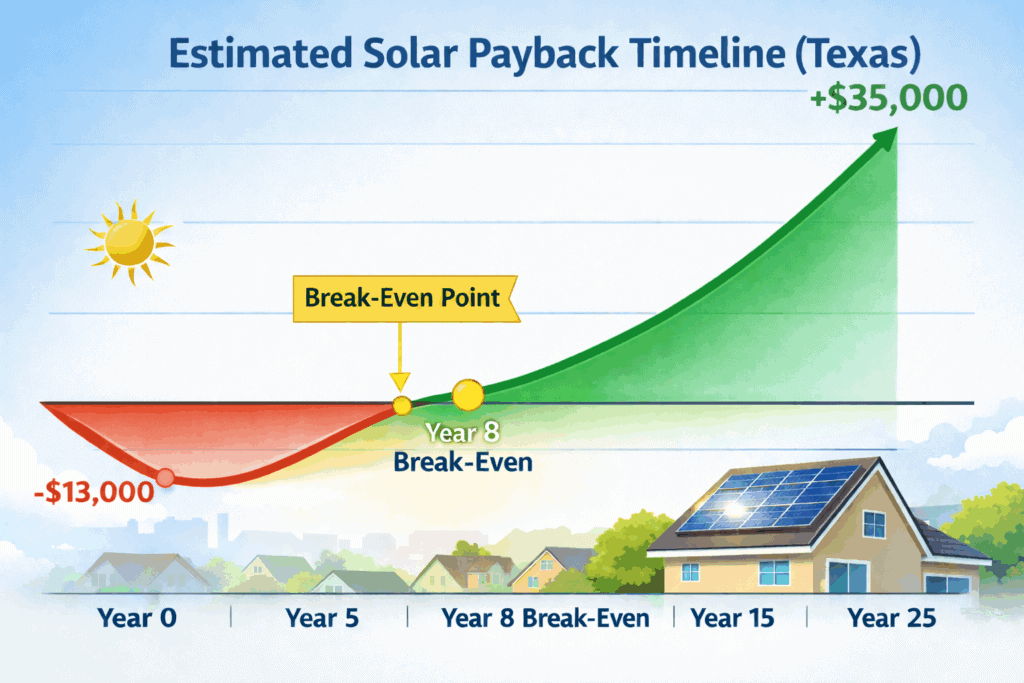
How Solar Savings Unfold Over Time
Most Texas homeowners reach breakeven within the first decade, then benefit from long-term savings.
Timeline reflects typical Texas residential systems. Actual payback depends on usage, rates, and financing.
Most Texas homeowners who go solar see their systems pay for themselves in 7 to 9 years. After that, it’s another 15 to 20 years of essentially free electricity (minus occasional maintenance). Over the life of the panels, that could lead to tens of thousands of dollars in savings.
But here’s the thing: solar isn’t automatic money for everyone. Your roof matters. Your electricity usage matters. How long you plan to stay in the house matters. And whether you’re paying cash or financing changes the math significantly.
Quick facts:
- Typical savings: $1,200–$1,800 per year
- Average payback: 7–9 years
- Federal tax credit: 30% of total system cost
- Panel lifespan: 25–30 years
- Best for: Homeowners with high usage and long-term plans
The Real Numbers: What Solar Actually Costs in Texas
Let’s start with the part everyone wants to know: the price tag.
Solar costs have dropped dramatically over the last decade, and Texas sits on the lower end of the national pricing spectrum. But “affordable” is relative when you’re looking at a five-figure investment.
What You’ll Actually Pay (2026 Pricing)
| System Size | Cost Before Tax Credit | After 30% Federal Credit | Who This Fits |
|---|---|---|---|
| 5 kW | $12,500–$15,000 | $8,750–$10,500 | Smaller homes, lower usage (under 800 kWh/month) |
| 7 kW | $17,500–$21,000 | $12,250–$14,700 | Average Texas household (1,000–1,200 kWh/month) |
| 10 kW | $25,000–$30,000 | $17,500–$21,000 | Larger homes, heavy A/C (1,500+ kWh/month) |
| 15 kW | $37,500–$45,000 | $26,250–$31,500 | Very large homes or extreme usage |
These aren’t teaser rates or promotional prices—they reflect what most homeowners actually pay after shopping around for quotes in 2026.
What Drives the Cost Up (or Down)
Panel quality and efficiency. You can buy budget panels at 17–19% efficiency or premium ones pushing 22–23%. The expensive ones produce more power per square foot, which matters if your roof space is limited. For most homes, mid-range panels (19–21% efficiency) hit the sweet spot.
Inverters. String inverters are cheaper upfront but create a single point of failure. Microinverters cost more but handle shading better and last longer. If you’ve got trees anywhere near your roof, microinverters usually pay for themselves.
Your roof. Simple roofs are cheaper to work with. If your installer has to navigate multiple roof planes, dormers, or skylights, labor costs go up. Same if you’ve got a tile or metal roof instead of asphalt shingles.
Battery backup (optional). This adds $8,000–$20,000 depending on capacity. Most people skip it initially. After the 2021 winter storm, though, batteries became a lot more popular in Texas—especially for folks who can’t afford to lose power for work or medical reasons.
The Costs Nobody Mentions Until You Ask
- Inverter replacement: Every 10–15 years, budget $1,500–$3,000
- Insurance bump: Expect $50–$100/year more on homeowners insurance
- Maintenance: Minimal if you get rain regularly, but occasional cleaning runs $100–$150
- Monitoring: Usually free, but some installers charge $100–$200/year
None of these are deal-breakers, but they’re real costs that affect your long-term ROI.
What You’ll Actually Save on Your Electric Bill
This is where the payback calculation starts making sense.
Annual Savings by City (Based on 7 kW System)
| City | Typical Rate* | Avg Annual Usage | Estimated Yearly Savings |
|---|---|---|---|
| Houston | ~14¢/kWh | ~14,200 kWh | $1,450–$1,750 |
| Dallas | ~13.8¢/kWh | ~13,800 kWh | $1,380–$1,650 |
| Austin | ~12.9¢/kWh | ~12,400 kWh | $1,240–$1,480 |
| San Antonio | ~13.1¢/kWh | ~13,600 kWh | $1,340–$1,600 |
| Fort Worth | ~13.9¢/kWh | ~13,500 kWh | $1,360–$1,630 |
*Rates vary by provider and can change. These are approximations based on EIA residential averages for 2025-2026.
A Real Example: What 25 Years Looks Like
Let’s say you install a 7 kW system in Dallas:
- Total cost after federal tax credit: $13,000
- Annual electricity savings: $1,500
- Payback period: About 8.7 years
Here’s where it gets interesting. After year 9, you’re saving $1,500 every single year with no more payments. If electricity rates rise 2–3% annually (which they have, historically), your savings actually increase over time.
By year 25:
- Total savings: ~$37,000
- System cost: $13,000
- Net profit: $24,000
And that’s assuming electricity rates stay relatively flat, which they won’t. Most financial models underestimate long-term solar savings because they don’t account for utility rate creep.
Why Texas Is Actually Great for Solar
We Use a LOT of Electricity
Texas homes consume about 40% more electricity than the national average. When your A/C runs six months a year, there’s just more usage to offset. More usage = bigger savings potential.
Compare that to, say, Oregon, where homes use far less power. A solar system there might save you $600/year. In Texas? Easily double that.
We Get a LOT of Sun
Most of Texas sees 220–300 sunny days per year depending on where you are. Even our cloudy days are brighter than a sunny day in Seattle.
Yes, extreme heat reduces panel efficiency slightly, about 5–10% on the hottest days, but the sheer volume of sunlight more than makes up for it. Annual production in Texas consistently outperforms cooler, cloudier states.
Property Tax Exemption (This Is Huge)
Texas law exempts residential solar from property tax assessments. That means you can add $20,000–$30,000 in home value without your property taxes going up a dime.
In states without this exemption, homeowners sometimes see their taxes jump after installing solar. Not here.
The Grid Reliability Thing
After February 2021, a lot of Texans started thinking about energy resilience differently.
Solar alone won’t keep your lights on during a blackout—unless you add a battery. But for homeowners who’ve sat through multi-day outages, the appeal of solar + storage is less about ROI and more about peace of mind.
Batteries are expensive. But if you work from home, have medical equipment, or just can’t deal with another week of cold showers, that cost might be worth it.
How Long Until Solar Pays for Itself?
Most systems in Texas break even in 7–9 years, but this is ultimately dependent on your personal situation.
Figures shown are estimates only and are based on publicly available data from sources such as the U.S. Energy Information Administration (EIA), EnergySage, and other industry research as of early 2026. Actual solar system costs, savings, incentives, and payback periods vary based on system size, electricity usage, utility rates, location, financing method, and available incentives. This information is provided for educational purposes and should not be considered financial, tax, or installation advice. Homeowners should consult qualified solar installers, tax professionals, or utility providers for personalized estimates.
What Speeds Up Payback
High electricity bills. If you’re already paying $200+ per month, solar offsets more cost faster.
Cash purchase. No loan interest means every dollar of savings goes toward payback.
South- or west-facing roof. Maximum sun exposure = maximum production.
Minimal shading. Trees are great for your yard, terrible for solar ROI.
What Slows It Down
Financing. Loan interest eats into your savings. A system that would pay for itself in 8 years with cash might take 11–12 years with a high-interest loan.
Low usage. If you only use 600 kWh/month, there’s just not enough cost to offset.
Heavy shading. Even partial shading can cut production by 30–50%.
Oversized system. Installing more capacity than you need doesn’t improve ROI—it just increases upfront cost.
Typical Payback by System Size
- 5 kW: 7–8 years
- 7 kW: 8–9 years
- 10 kW: 8–10 years
- 15 kW: 9–11 years
Larger systems take slightly longer to recover costs, but they usually deliver higher total lifetime savings. It’s the difference between breaking even faster and making more money overall.
When Solar Doesn’t Make Sense
I’m going to level with you: solar isn’t the right move for everyone.
You’re Planning to Move Soon
If you’re selling within 5–7 years, you probably won’t hit payback. Solar does increase home value, but it’s hard to recover 100% of system cost at resale. Some buyers love it, some don’t care, and a few actively avoid it (unfairly, but still).
Your Roof Is Old
If your shingles have less than 15–20 years of life left, replace the roof first. Removing and reinstalling panels later costs $2,000–$5,000, which kills your ROI.
Most installers won’t even touch a roof that’s near end-of-life. Save yourself the hassle and re-roof before going solar.
You’ve Got Heavy Shade
A few trees here and there? Usually fine, especially with microinverters. But if your roof is under a canopy all day, solar production drops by 40–80%.
At that point, you’re not generating enough power to justify the cost. Trimming trees helps, but not everyone wants to cut down their 50-year-old oak for marginal solar gains.
You Rent or Don’t Own the Property
Solar incentives go to the system owner. Renters can’t install panels (and even if your landlord agreed, you wouldn’t get the tax credit). Your only option is community solar, which has its own pros and cons.
You Use Very Little Electricity
If your monthly bill is under $70–$80, you’re probably using less than 500 kWh. At that level, even a small 3–4 kW system might not pencil out financially.
You’re better off investing in insulation, a more efficient A/C, or LED bulbs before considering solar.
What Actually Affects Your ROI
Not all solar systems are created equal, and a few key factors determine whether you’re looking at an 8-year payback or a 12-year slog.
Your Electricity Rate
If you’re in a deregulated area (most of Texas), your rate depends on which retail provider you chose. Some people pay 11¢/kWh, others pay 17¢/kWh for the same usage.
If you’re on the high end, solar becomes even more attractive. If you’re on the low end, it still works—just takes longer to break even.
Net Metering (Or Lack Thereof)
Texas doesn’t require utilities to offer net metering, so policies vary. Some retail electricity providers credit you at the full retail rate for excess power you send to the grid. Others pay wholesale rates, which are much lower.
This affects how much you save if your system produces more than you use during the day. Before signing with an installer, check what your local utility or REP actually offers.
Roof Direction and Angle
South-facing: Ideal. 100% production potential. West-facing: Nearly as good. Captures afternoon sun when A/C usage peaks. East-facing: Solid, especially if you use a lot of power in the morning. North-facing: Not recommended unless you have no other option.
Flat roofs work fine but usually require tilt racks, which add cost.
Equipment Quality
Cheap panels and cheap inverters save money upfront but often cost more long-term. Budget equipment tends to:
- Degrade faster
- Have shorter warranties
- Fail sooner
Spending an extra $1,500–$3,000 on quality equipment usually pays for itself in reliability and production over 25 years.
How You Pay for It
- Cash: Best ROI. No interest, fastest payback.
- Solar loan (low APR): Still good. Payback takes 2–3 years longer.
- Solar loan (high APR): Questionable. Interest can erase a big chunk of your savings.
- Lease/PPA: Generally not recommended in Texas. You get minimal savings and none of the tax benefits.
Do Solar Panels Actually Work in Texas Heat?
Yes, despite what your neighbor’s brother-in-law told you at the BBQ.
There’s a persistent myth that solar panels don’t work well in hot climates. It’s based on a real thing (temperature coefficient) but blown way out of proportion.
Here’s Why
Solar panels are slightly less efficient at very high temperatures. On a 105°F day, production might drop 5–10% compared to ideal conditions (77°F).
But here’s what matters more: total sunlight hours.
Texas gets dramatically more sun than cooler states. Even with the heat penalty, a panel in Houston produces far more electricity annually than the same panel in Portland or Seattle.
It’s like saying a car gets worse gas mileage going uphill. True, but irrelevant if you’re driving downhill the rest of the time.
Durability in Texas Weather
Modern panels are tested for:
- Hail: Rated for 1-inch hailstones at 50 mph
- Wind: Hurricane-force sustained winds
- Temperature swings: -40°F to 185°F
Most manufacturers offer 25-year performance warranties and 10–15 year product warranties. If panels fail due to weather, they’re replaced.
Insurance covers hail damage (same as your roof), and the premium increase is minimal—usually $50–$100/year.
Will Solar Increase Your Home Value?
Probably, but don’t count on it for your ROI calculation.
What the Research Shows
National studies (Berkeley Lab, Zillow) suggest solar increases home value by about 4% on average, or around $15,000 for a median-priced home.
In practice, it depends heavily on:
- Your market. Solar adds more value in Austin and Dallas than in rural areas.
- Ownership. Owned systems add value. Leased systems can actually hurt resale (buyers don’t want to inherit your payment).
- System age. A 2-year-old system is an asset. A 12-year-old system with aging equipment is neutral at best.
Homes Sell Faster
There’s consistent data showing solar homes spend less time on the market—about 20% faster than comparable non-solar homes.
Whether that translates to a higher sale price is hit-or-miss. Some buyers value it highly. Others see it as a liability (more complexity, potential maintenance).
Bottom line: Solar might add value, but don’t install it just for resale purposes. The real ROI comes from years of electricity savings, not a one-time home sale boost.
So… Is Solar Worth It for You?
For most Texas homeowners? Yes.
If you:
- Own your home and plan to stay 7+ years
- Use above-average electricity (1,000+ kWh/month)
- Have a decent roof with minimal shading
- Can afford the upfront cost (or qualify for favorable financing)
…then solar delivers solid long-term savings and a reasonable payback timeline.
If you’re renting, planning to move soon, have a roof that needs replacement, or use very little power, solar probably doesn’t make financial sense right now.
What to Do Next
The best way to know if solar works for your specific situation is to get a few quotes. Real quotes—not ballpark estimates—based on your actual roof, usage, and local electricity rates.
Compare at least three installers. Ask about equipment brands, warranties, financing terms, and what happens if you need service years down the road.
And most importantly: don’t let anyone pressure you into signing the same day. This is a 25-year investment. You can take a week to think about it.
Sources & Methodology
All cost and savings estimates in this guide are based on:
- U.S. Energy Information Administration (EIA): Residential electricity rates and consumption data
- National Renewable Energy Laboratory (NREL): PVWatts solar production modeling and resource maps
- EnergySage: 2025-2026 residential solar pricing trends
- Lawrence Berkeley National Laboratory: “Selling Into the Sun” research on solar and home values
- Zillow: Housing market data on solar premiums
Cost ranges reflect typical residential installations in Texas metro areas as of January 2026. Individual quotes may vary based on location, installer, equipment selection, and roof complexity.
Frequently Asked Questions
How much do solar panels save on electricity bills in Texas? Most Texas homeowners save $1,200–$1,800 per year with a properly sized system. Actual savings depend on your electricity rate, usage, and how much sun your roof gets.
What solar incentives are available in Texas? The main incentive is the federal 30% tax credit (ITC), which runs through 2032. Texas also exempts solar equipment from property tax assessments. Some utilities offer additional rebates—check with your local provider. If you’re interested in solar energy, you might also want to explore california solar tax credits explained. These incentives can significantly reduce your upfront costs, making solar installations more accessible. Additionally, understanding how these credits work can help you maximize your savings on your investment in renewable energy.
Do I need a battery with my solar panels in Texas? No, but batteries have become more popular since the 2021 winter storm. Standard grid-tied systems work fine for most people. If you want backup power during outages, you’ll need to add a battery (which costs $8,000–$20,000).
Can solar panels power my home during a Texas blackout? Only if you have a battery backup system. Standard grid-tied solar shuts off automatically during outages for safety reasons. Solar + battery can keep essential circuits running.
How long do solar panels last in Texas? 25–30 years. Most panels come with 25-year performance warranties guaranteeing at least 80–85% output by year 25. Inverters typically need replacement around year 10–15.
Will my HOA allow solar panels in Texas? Texas law protects solar rights, but HOAs can impose “reasonable restrictions” on placement and appearance. Some HOAs are fine with it, others make it difficult. Check your HOA rules before proceeding.
How does net metering work in Texas? Texas doesn’t mandate net metering, so policies vary by utility and retail electricity provider. Some credit you at retail rates for excess power, others pay wholesale rates. Always ask what your specific REP offers.
Ready to see what solar would actually cost for your home? Get free quotes from multiple installers and compare pricing, equipment, and warranties before making a decision.
Compare Your Electricity Usage
Electricity bills can feel unpredictable — especially when prices change or usage spikes. This estimator provides context by comparing your monthly usage to statewide residential electricity averages.
There’s no sign-up and no plan comparisons here. Just a simple way to understand how your electricity usage compares to typical households in your state.
Estimates are based on average residential electricity prices by state, published by the U.S. Energy Information Administration (EIA). Calculations use a typical household usage benchmark for comparison.
Electricity Bill Estimator
Source: U.S. Energy Information Administration (EIA)