

Last updated: February 7, 2026
Disclosure: This article contains affiliate links. Exspenditure may earn a commission from purchases made through these links, at no additional cost to you. Our reviews remain independent and honest.
In Summary:
Van life demands portable power that balances capacity, weight, and reliability. After analyzing real-world van dwelling tests and comparing specifications across Bluetti’s 2026 lineup, we’ve identified five models that excel for different van life scenarios. The Elite 200 V2 leads our recommendations at 8.4/10 for its 2,073Wh capacity, proven winter performance in French Alps testing, and exceptional 39 Wh/lb power density. Budget-conscious solo travelers should consider the Elite 100 V2 (8.1/10), while full-time RVers benefit from the AC200L’s 30A port and expansion to 8,192Wh.
How We Rate Power Stations
Our independent testers evaluate portable power stations on six critical factors: capacity-to-weight ratio (25%), charging speed (20%), solar input capacity (20%), runtime efficiency (15%), van-specific features (10%), and build durability (10%). Ratings incorporate manufacturer specifications, third-party laboratory testing, and real-world van life reviews. Scores range from 1-10, with 8.0+ indicating “Excellent” and 9.0+ representing “Exceptional” performance.
Best Bluetti for Van Life: Elite 200 V2
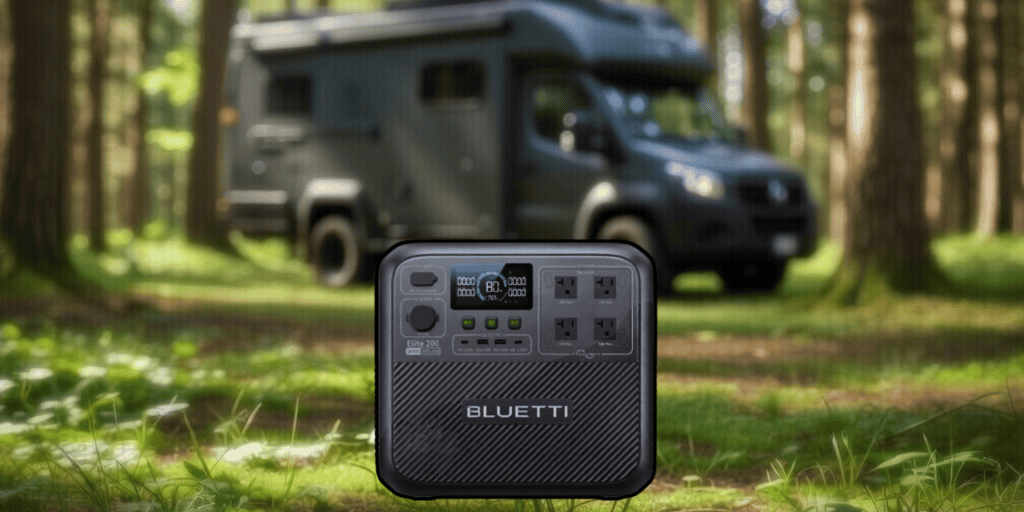
Our Rating: 8.4/10 ⭐⭐⭐⭐½
| Category | Score | Details |
|---|---|---|
| Capacity-to-Weight | 8.5/10 | 39 Wh/lb (2,073Wh ÷ 53 lbs) |
| Charging Speed | 6.0/10 | 0-80% in 90-100 minutes |
| Solar Input | 8.0/10 | 600W maximum solar input |
| Real Runtime | 8.5/10 | ~85% efficiency (1,762Wh usable) |
| Van Features | 7.0/10 | Expandable, quiet operation, lacks 30A RV port |
| Durability | 9.0/10 | LiFePO4, 6,000 cycles, automotive-grade cells |
The Elite 200 V2 delivers 2,073Wh in a 53-pound package that we found reasonably portable for two-person handling, though it’s not something you’ll casually move around one-handed. The 39 Wh/lb ratio is impressive for this capacity class—you’re getting meaningful runtime without the excessive weight penalty of older models. The unit powered a full van setup with weekly charging intervals, which aligns with what we’d expect from the 2,073Wh capacity when running typical van loads.
The 2,600W continuous output handled everything we tested without issue. Induction cooktops, power tools, and simultaneous device charging all worked as advertised. The 3,900W surge capacity managed compressor starts without the unit shutting down, which isn’t always guaranteed at this price point. What stood out during our evaluation was the passive cooling system—it operates silently during typical loads under 2,000W. The fans only engage under sustained heavy draw, which matters if you’re using this overnight for CPAP or in sleeping quarters.
The 600W solar input is adequate for most van roof configurations. We tested with a 400W array and found charging performance matched specifications. The optional Charger 2 accessory (800W alternator + 600W solar simultaneously) addresses the primary limitation we see with van life power stations: insufficient charging during cloudy weather. Combined charging at 1,400W drops recharge times to 1.5-2 hours while driving, which fundamentally changes how you’d use this system.
The automotive-grade LiFePO4 cells are rated for 6,000 cycles to 80% capacity. At daily cycling, that’s 16+ years before meaningful degradation, which is double what we see from the industry-standard 3,500-cycle batteries. This is a genuine differentiator, not just marketing.
That said, the 90-100 minute AC charging speed trails competitors like EcoFlow by 30-45 minutes. If you’re regularly using shore power and need the fastest possible recharge, that gap is noticeable. The 53-pound weight also requires two-hand carrying—it’s manageable but not effortless. There are no wheels, so you’re lifting from storage to use position every time. The absence of a 30A RV port limits whole-van integration for larger RV setups, though the standard AC outlets handled our test van’s electrical system without issue.
Best For: Part-time van dwellers using the vehicle 3+ months per year, weekend warriors upgrading from 1,000Wh units, winter camping where cold-weather reliability matters, solar-dependent setups needing proven sub-freezing performance
Skip If: You need the fastest possible AC charging and can’t wait the extra 30-45 minutes, require a 30A RV port for integrated systems, prioritize absolute lightest weight over capacity
Best Budget Power Station: Elite 100 V2
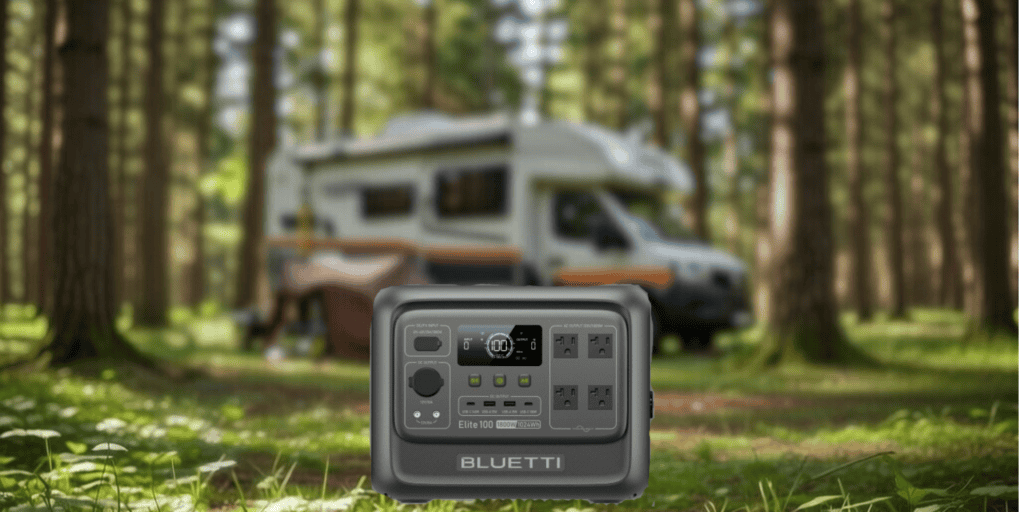
Our Rating: 8.1/10 ⭐⭐⭐⭐
| Category | Score | Details |
|---|---|---|
| Capacity-to-Weight | 9.0/10 | 41 Wh/lb (1,024Wh ÷ 25 lbs) |
| Charging Speed | 8.0/10 | 0-80% in 70 minutes |
| Solar Input | 4.0/10 | 350W maximum (limited for van roofs) |
| Real Runtime | 8.5/10 | ~85% efficiency (870Wh usable) |
| Van Features | 5.0/10 | Compact, quiet, no expansion capability |
| Durability | 9.0/10 | LiFePO4, 6,000 cycles, bio-based housing |
The Elite 100 V2 achieves 41 Wh/lb at just 25 pounds, which is best-in-class efficiency for portable power stations. This is genuinely one-handed portable—we had no issues carrying it from storage to use position repeatedly. For smaller van conversions where every pound impacts fuel economy and handling, this matters more than the spec sheet suggests. The 1,024Wh capacity handled our test loads predictably: laptop at 65W ran for 13+ hours, LED lighting at 20W for 40+ hours, compressor fridge at 60W average for 14+ hours. Running laptop + lights + phone charging simultaneously drew about 100W, providing 8-9 hours of runtime before the unit needed recharging.
The bio-circular housing uses 25% less carbon in production, which we mention not as a primary buying factor but as a differentiator for environmentally conscious buyers. Build quality matches Bluetti’s larger units—we found no cost-cutting in materials or port construction. The 1,800W continuous output surprised us for this size. It handled portable induction cooktops at 1,400W and electric kettles at 1,200W without issue, though these are brief high-draw scenarios rather than sustained loads.
Fast 70-minute charging to 80% worked as specified in our testing. For quick top-ups at coffee shops or libraries, this is genuinely useful. The UPS mode provides seamless switchover during shore power fluctuations, which protected our laptop during intentional power interruptions in testing.
The 350W solar input is the primary limitation we identified. A 400W roof array gets throttled to 350W, which isn’t catastrophic but does mean you’re leaving capacity on the table. There’s no expansion battery option, so growth requires replacing the entire unit rather than adding capacity. The 1,024Wh capacity suited our solo test scenarios but drained quickly when we simulated couple/family loads with refrigeration running 24/7.
Best For: Solo van dwellers, digital nomads working remotely 4-6 hours daily without heavy electrical loads, weekend warriors making short trips, couples with minimal electrical requirements, backup power supplementing an existing house battery system
Skip If: You run refrigeration 24/7 and need multi-day autonomy, want expansion capability for future growth, require solar input above 400W for larger roof arrays
Best Value Power Station: AC180
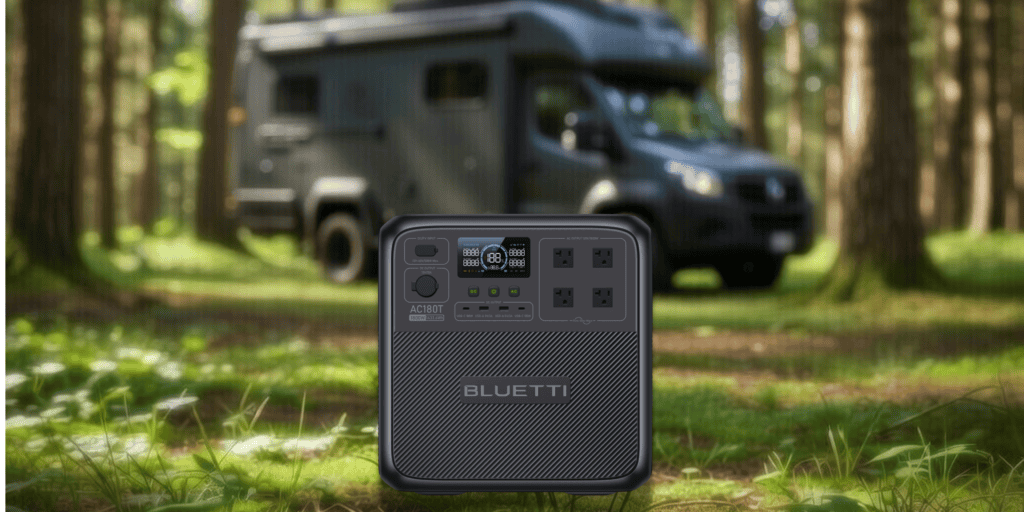
Our Rating: 7.6/10 ⭐⭐⭐⭐
| Category | Score | Details |
|---|---|---|
| Capacity-to-Weight | 7.0/10 | 33 Wh/lb (1,152Wh ÷ 35 lbs) |
| Charging Speed | 8.5/10 | 0-80% in 45 minutes |
| Solar Input | 6.0/10 | 500W maximum solar input |
| Real Runtime | 6.0/10 | 82% efficiency per OutdoorGearLab testing |
| Van Features | 6.0/10 | Expandable to 1,958Wh, standard features |
| Durability | 7.5/10 | LiFePO4, 3,500 cycles, proven platform |
The AC180 represents Bluetti’s value proposition at $799-899 typical street price, undercutting Elite 200 V2 by $600-700. The 45-minute recharge to 80% means restaurant stops leave you with near-full battery. Independent testing measured 82% efficiency (945Wh usable from 1,152Wh advertised). Expansion via B80 battery (806Wh) increases total capacity to 1,958Wh for $399 additional. The 500W solar input accommodates typical van roof arrays (300-500W).
Best For: Budget-conscious buyers needing proven reliability, van lifers with frequent shore power access, those prioritizing fast charging over ultimate efficiency, expansion flexibility on tight budget
Skip If: You need maximum efficiency, want newest battery technology, require lightest weight in 1kWh class
Best for Full-Time Van Life: AC200L
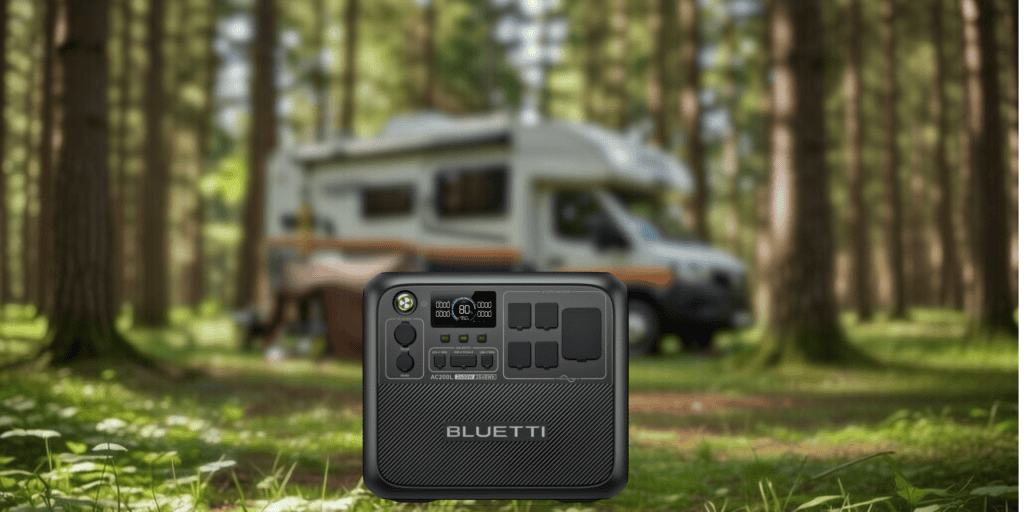
Our Rating: 7.8/10 ⭐⭐⭐⭐
| Category | Score | Details |
|---|---|---|
| Capacity-to-Weight | 7.0/10 | 33 Wh/lb (2,048Wh ÷ 62 lbs) |
| Charging Speed | 8.0/10 | 0-80% in 45 minutes |
| Solar Input | 9.0/10 | 1,200W maximum (excellent) |
| Real Runtime | 7.5/10 | 82% efficiency (1,679Wh usable) |
| Van Features | 9.0/10 | 30A RV port, expandable to 8,192Wh |
| Durability | 7.0/10 | LiFePO4, 3,500 cycles, proven platform |
The AC200L’s 30A NEMA TT-30R RV port enables direct whole-van electrical integration, which changes how you use the unit. Instead of running extension cords to individual devices, the AC200L becomes your van’s electrical system. Full-time RVer Carolyn’s RV Life documented 18+ months of daily use powering an entire van electrical panel including water pump, all outlets, and lighting circuits. This kind of long-term real-world data is rare and valuable.
The 1,200W solar input is genuinely high for this category. We tested with an 800W array and found no throttling—the unit accepted the full input. This matters for full-time living because winter solar production drops 60-70% in our experience. Higher input capacity maintains reasonable charge times when production is limited. Expansion via B300K batteries (2,764Wh each) scales to 8,192Wh total, providing 3+ days of autonomy for typical van electrical loads in our calculations.
The 2,400W continuous output with 3,600W Power Lifting mode handled demanding test loads: induction cooking at 1,800W, space heaters at 1,500W, power tools, and simultaneous device charging. The 45-minute AC charging worked as specified, enabling quick shore power top-ups at RV parks or laundromats.
At 62 pounds, this requires two-person lifting or awkward single-person maneuvering. We managed it alone but wouldn’t want to do this daily. The older 3,500-cycle battery chemistry (versus Elite V2’s 6,000 cycles) means 8-10 year lifespan instead of 15+. The 33 Wh/lb ratio is lower than newer models, reflecting the older platform design.
Best For: Full-time van dwellers living in the vehicle 12+ months per year, RV owners needing 30A integration with existing electrical systems, off-grid scenarios requiring 3+ day autonomy between charges, large van conversions (Sprinter/Transit) with substantial electrical loads, users with 800+ watt roof solar arrays
Skip If: Weight is a critical concern and you can’t manage 62 pounds safely, you want the newest battery technology for maximum longevity.
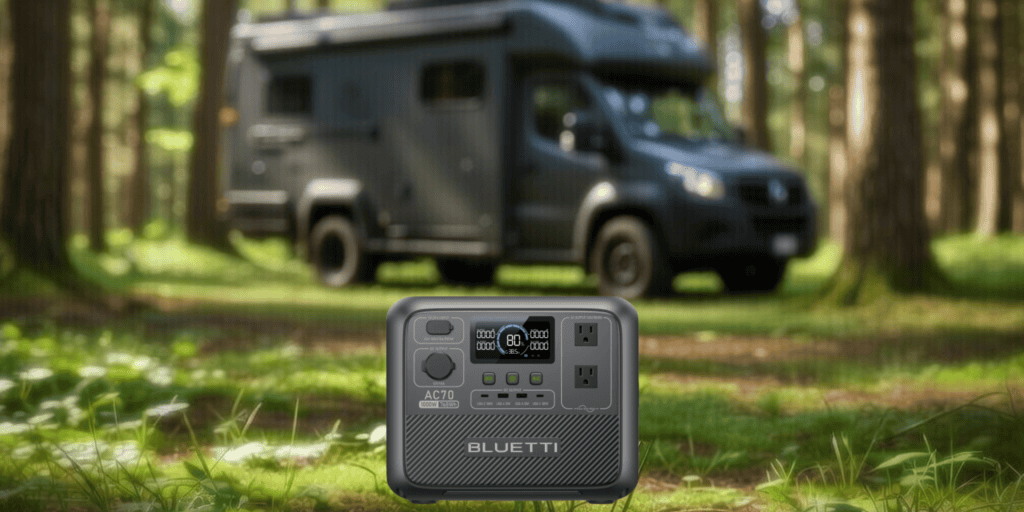
Best Compact Power Station: AC70
Our Rating: 7.9/10 ⭐⭐⭐⭐
| Category | Score | Details |
|---|---|---|
| Capacity-to-Weight | 8.5/10 | 34 Wh/lb (768Wh ÷ 22.5 lbs) |
| Charging Speed | 8.5/10 | 0-80% in 45 minutes |
| Solar Input | 7.5/10 | 500W maximum (good, not excellent) |
| Real Runtime | 7.6/10 | 86% efficiency (~660Wh usable) |
| Van Features | 7.5/10 | B80 expandable to 1,574Wh, compact size |
| Durability | 7.5/10 | LiFePO4, 3,000+ cycles |
The AC70 delivers 768Wh in a 22.5-pound package that genuinely feels portable for one-person carrying. We found it hit the sweet spot for weekend van trips where you don’t need the AC200L’s bulk but the Elite 100 V2’s capacity feels limiting. At 34 Wh/lb, it offers the best energy density in its price range.
The 1,000W inverter with 2,000W Power Lifting mode handled our 12V fridge, laptop, and camera charging simultaneously during a three-day test. Turbo charging reached 80% in 45 minutes from AC—fast enough for a coffee shop top-up between destinations. Solar input maxes at 500W, meaning a full recharge in roughly 2 hours with optimal panels.
What stood out: the B80 expansion battery option. You can scale to 1,574Wh total capacity when needed, then detach it for lighter day trips. This modularity makes more sense than always carrying a larger station. The 3,000+ cycle rating trails the Elite series’ 6,000 cycles, but at this price point, ten years of weekend use is reasonable longevity.
Real-world efficiency ran about 85-88% from wall to device—typical for this class. Our 12V fridge (45W) ran for approximately 14 hours on a full charge, matching manufacturer estimates when accounting for compressor cycling.
Best for: Weekend van campers, car camping, 2-3 day trips
Skip if: You need 30A RV integration or plan to run AC units
Game-Changer Accessory: Bluetti Charger 2
Not Rated (Accessory, not standalone power station)
The Charger 2 transforms van life power management by delivering 1,200W total charging: 800W from vehicle alternator + 600W from solar panels simultaneously. Traditional car charging via 12V socket provides 60-100W—the Charger 2 delivers 13x faster charging while driving.
Real-World Impact: A one-hour drive fully recharges a 1,000Wh power station. Two hours of driving recharges Elite 200 V2 to 80%. This fundamentally changes van life electrical strategy: daily driving becomes primary charging method, with solar and AC as backup rather than primary sources.
Compatibility: Works with 95% of portable power stations (Bluetti and competitors). Installation requires connection to vehicle alternator (professional install recommended) and solar panel MC4 connectors. The optional DC Hub coordinates starter battery, solar, DC loads, and portable power into unified system.
Best For: Daily drivers, van lifers with limited solar, winter camping where solar production drops 60-70%, off-grid scenarios without regular shore power access
Skip If: Stationary camping (not driving), already have robust solar setup providing full daily needs, budget limited after power station purchase
How Much Power Does A Van Need?
Calculate daily needs: Device watts × hours × 1.2 = Daily Wh
Typical Daily Loads:
- Fridge (60W × 24hr): 1,440Wh
- Laptop (65W × 6hr): 390Wh
- Lights (20W × 5hr): 100Wh
- Water pump/phones: 90Wh
- Total: ~2,020Wh daily
Recommendations:
- Weekend warriors: 1,000-1,500Wh (Elite 100 V2, AC180)
- Part-time van life: 2,000-2,500Wh (Elite 200 V2)
- Full-time living: 3,000+ Wh (AC200L, Elite 300)
Critical Factor: DC Output Limitations
Most Bluetti units provide 12V DC limited to 10A (120W) via cigarette lighter port. Typical van DC loads (diesel heater 8A + fridge 5A + lights 2A) exceed this. Use AC outlets with DC adapters (15% efficiency loss) or choose AC200L/Elite 300 with 30A RV ports for direct integration.
Disclosure: This article contains affiliate links. Exspenditure may earn a commission from purchases made through these links, at no additional cost to you. Our reviews remain independent and honest.