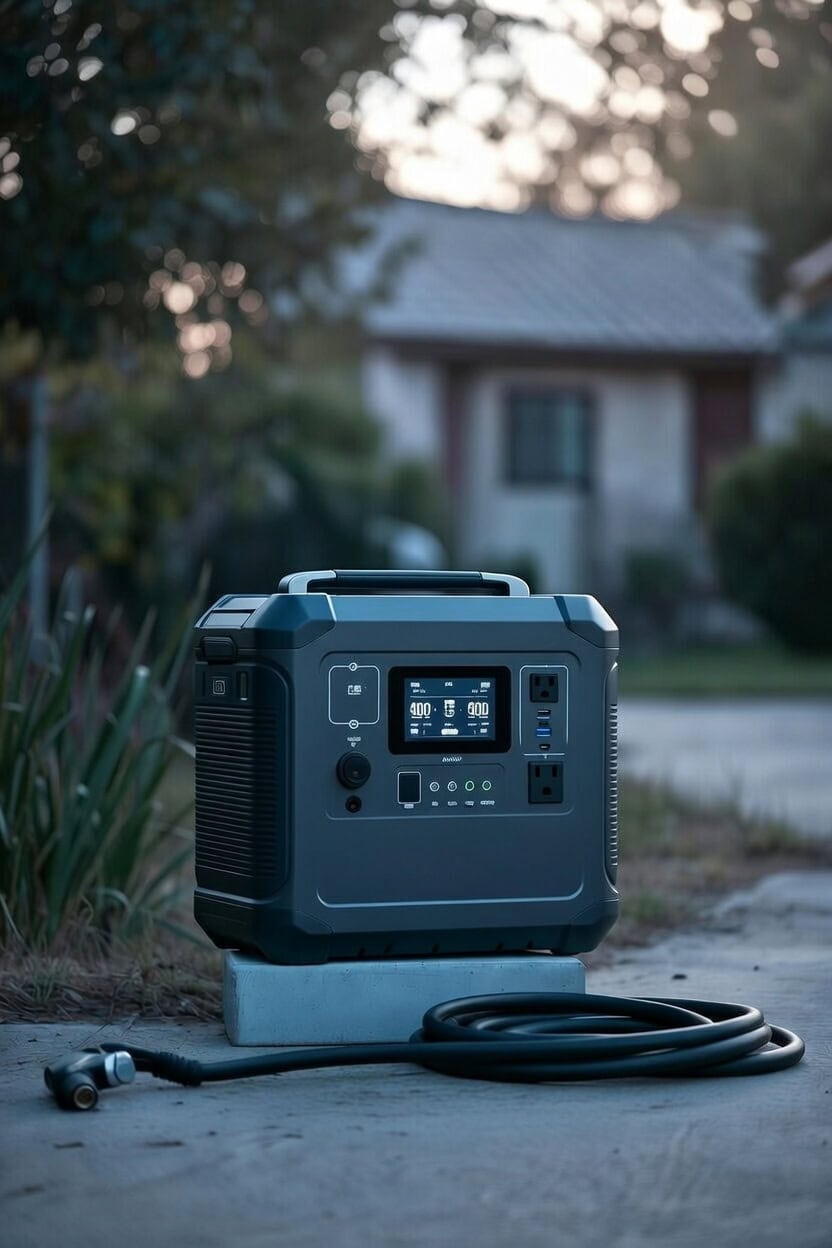
In Summary: Yes — most portable power stations support this. It’s called pass-through charging, and for modern units with LiFePO4 batteries and a smart internal circuit, it’s safe for occasional use. The key word is occasional. Doing it constantly, especially with older or budget units, will wear down the battery faster than standard charge/discharge cycles. Here’s what actually matters and what the major brands say about their own products.
What Pass-Through Charging Actually Means
Pass-through charging means you can plug the power station into a wall outlet (or solar panel) to charge it, while simultaneously powering devices through its output ports. The unit charges and powers your gear at the same time.
The name comes from the underlying circuit behavior. In a well-designed unit, power from the wall goes directly to your connected devices first. The battery only charges on the leftover current. The electricity essentially “passes through” to your devices rather than routing through the battery in both directions at once.
In a cheaply built unit, it works differently — power goes in and out of the battery simultaneously, which generates heat and accelerates wear. This is the version worth worrying about.
Is It Safe?
For the major brands selling in 2025 and 2026, yes — with a few caveats.
EcoFlow, Bluetti, and Jackery all confirm pass-through charging is supported across their current lineups. Each brand uses a priority power supply circuit in their modern units: wall power goes to your devices first, battery charging happens second. This keeps heat low and avoids stressing the battery cells from both sides at once.
That said, all three brands include the same underlying advice: don’t make it your default mode. Running pass-through continuously — meaning the unit stays plugged in and powering devices for days at a stretch — creates sustained low-level heat stress that shortens battery life over time.
The short answer: Safe for hours at a time. Not ideal as a permanent setup.
What the Brands Actually Say
| Brand | Pass-Through Supported? | Official Guidance | Battery Chemistry |
|---|---|---|---|
| EcoFlow (DELTA / RIVER 2 series) | Yes | Supported; uses priority power supply circuit; switchover under 30ms | LiFePO4 (LFP) |
| Bluetti (AC200L) | Yes | Supported; 20ms EPS/UPS switchover; no stated restrictions on duration | LiFePO4 (LFP) |
| Jackery (all models except Explorer 160) | Yes | Supported; recommends use only when device draw is less than input wattage; advises against frequent use to preserve battery health | LiFePO4 (LFP) on v2/Plus/Pro models; NMC on older models |
Sources: EcoFlow US Blog (September 2025), Bluetti AC200L official product page (verified February 2026), Jackery official FAQ and Explorer 2000 v2 product page. Always check your specific model’s manual for confirmed specifications.
Why Battery Chemistry Changes the Risk Level
This is the part most articles skip, and it’s the most important factor for long-term battery health.
Older and budget portable power stations often use NMC (Nickel Manganese Cobalt) batteries. NMC cells have lower thermal stability — they’re more susceptible to heat damage and typically rate for 500 to 1,000 charge cycles. When you run pass-through charging on an NMC unit, the heat generated degrades the battery faster.
Newer units from the major brands — EcoFlow’s DELTA and RIVER 2 series, Bluetti’s AC200L and AC180, Jackery’s v2 and Plus models — use LiFePO4 (LFP) chemistry. LFP cells handle heat far better, and rate for 3,000 to 4,000 cycles. Pass-through charging on an LFP unit is significantly less damaging than on an older NMC unit.
If you’re running pass-through on a unit you bought before 2022, check whether it’s LFP or NMC before making it a habit. If it says “lithium-ion” without specifying LFP or LiFePO4, it’s almost certainly NMC. See our LiFePO4 vs NMC comparison for a deeper breakdown of what that means for real-world use.
The One Scenario Where It Gets Complicated
Pass-through charging works cleanly when your input power exceeds your output draw. If you’re pulling 200W from the unit while it’s charging at 400W, there’s spare capacity — the battery charges, devices run, no problem.
The issue arises when your output demand approaches or exceeds the input. Jackery specifically flags this in their official FAQ: they recommend pass-through only when device power draw is less than the input wattage showing on screen. If your combined device load exceeds what’s coming in, the battery has to make up the shortfall — which is exactly the simultaneous charge/discharge situation that causes wear.
Practical example: you’re charging a Bluetti AC200L (2,400W max input) from a wall outlet while running a mini fridge (150W) and charging a laptop (65W). Total draw is 215W against 2,400W input. No issue. But if you’re solar charging at 400W on a cloudy afternoon and trying to run a 600W appliance at the same time — the battery is actively discharging under load while trying to charge. That’s where wear accumulates.
Does It Charge Your Devices More Slowly?
Yes, slightly. The unit has to share incoming power between your devices and its own battery. Devices always get priority — the battery charges on what’s left. If you’re running a heavy load, the battery may charge slowly or not at all until that load drops. This is normal behavior, not a malfunction.
It won’t hurt your connected devices. The power delivered to them is clean and regulated. What changes is how long the unit’s battery takes to reach full charge.
What About Using It as a UPS?
Pass-through charging is closely related to UPS (Uninterruptible Power Supply) mode, but they’re not identical. A true UPS switches to battery power in milliseconds when grid power drops. Modern portable power stations with EPS (Emergency Power Supply) mode do the same thing — EcoFlow’s DELTA series switches in under 30ms, Bluetti’s AC200L in under 20ms, Jackery’s 2000 v2 in under 20ms.
This makes these units functional as light UPS replacements for laptops, routers, and CPAP machines during brief outages. They’re not rated for sensitive equipment like servers or medical devices where zero interruption is critical — for those applications, a dedicated UPS is the right tool.
If you’re considering this setup, check that your specific model lists EPS or UPS mode explicitly. Not all models in a brand’s lineup support it, and the switchover time varies.
How to Minimize Wear If You Use It Regularly
If pass-through charging is part of how you use your unit — as a desktop buffer, an RV power hub, or a home backup that stays plugged in — a few habits reduce long-term wear:
Keep the battery level between 20% and 80% during extended pass-through use. Most modern units let you set a charge ceiling in the app. Staying off the extremes reduces the stress on battery cells during sustained use.
Give the unit a cool environment. Heat accelerates degradation regardless of battery chemistry. A unit sitting in a 95°F vehicle or enclosed cabinet during pass-through charging will wear faster than one in a ventilated, room-temperature space. This also explains why the fan may run more often during pass-through — see our guide on why portable power station fans run constantly.
Keep firmware updated. EcoFlow, Bluetti, and Jackery all push firmware updates that optimize power management, including how pass-through is handled. Registering your unit ensures you get those updates.
Frequently Asked Questions
Will using pass-through charging void my warranty?
No — not for EcoFlow, Bluetti, or Jackery. All three brands officially support the feature. What can affect warranty coverage is using incompatible third-party chargers, operating outside stated temperature ranges, or physical damage. Using the pass-through feature as designed does not void coverage. Always verify with your specific model’s documentation.
Can I leave my power station plugged in permanently?
Most units have overcharge protection that stops battery charging once full, but sustained heat from extended plug-in time still has an effect over months and years. If long-term battery life matters, set a charge ceiling in the app (80% is a common recommendation) and avoid storing in hot environments.
Does pass-through work with solar input?
Yes. The same circuit applies — solar power goes to your devices first, battery charges on the remainder. The main variable is cloud cover. On a cloudy day, solar input may drop below your device load, causing the battery to fill the gap. This is fine occasionally but accelerates wear if it’s a daily pattern.
What if something goes wrong while using pass-through charging?
Stop using the unit and contact the manufacturer. If you notice unusual heat, strange smells, swelling, or error codes you don’t recognize, disconnect the unit from power and from all devices. Don’t attempt to open or repair the unit yourself. See our portable power station charging troubleshooting guide for common error patterns and what they indicate.
Disclaimer: This article is for general informational purposes only. Specifications, supported features, and warranty terms vary by model and can change. Always consult your unit’s official user manual and the manufacturer’s website before use. Pass-through charging behavior described here reflects publicly available documentation from EcoFlow, Bluetti, and Jackery as of February 2026. Exspenditure is not responsible for damage resulting from use decisions made based on this content. Some links in this article may be affiliate links, meaning we may earn a commission if you purchase through them at no additional cost to you — see our Affiliate Disclosure for full details.